
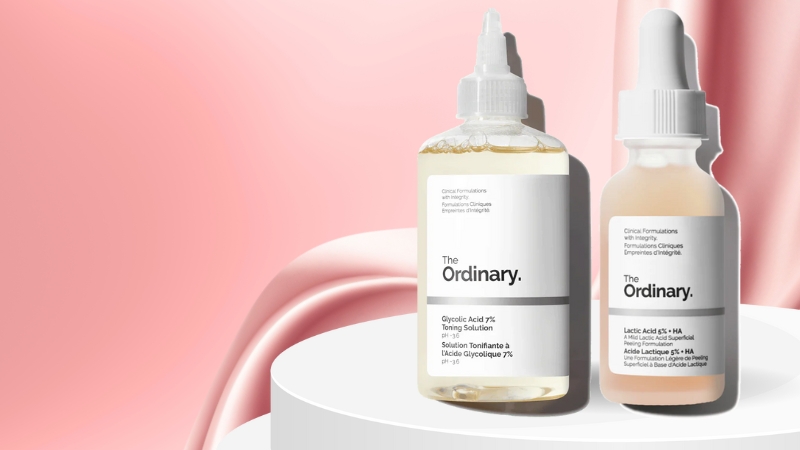
For sensitive skin, lactic acid is generally the safer and more predictable exfoliant, while glycolic acid offers stronger results but carries a higher irritation risk.
The difference comes down to molecular size, penetration depth, and how each acid interacts with the skin barrier. Glycolic acid exfoliates more aggressively and works faster, but that same efficiency makes it harder for reactive or easily inflamed skin to tolerate.
Lactic acid exfoliates more slowly, draws moisture into the skin, and is better aligned with the needs of sensitive skin types, including rosacea-prone and barrier-impaired skin.
What Glycolic Acid Is and How It Works
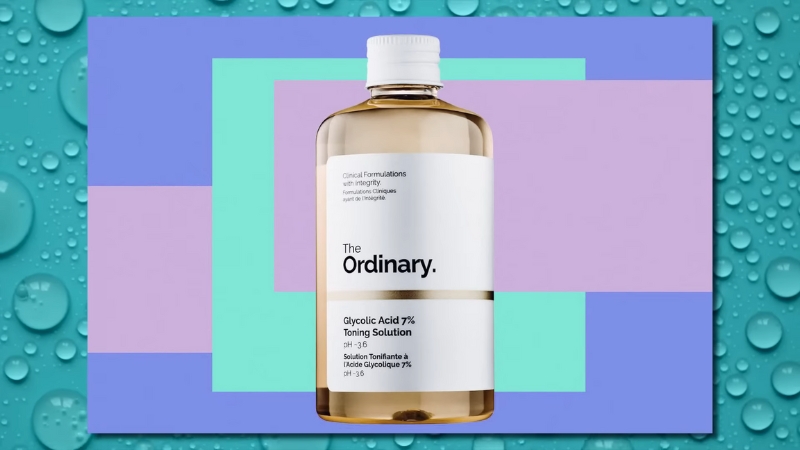
Glycolic acid is an alpha-hydroxy acid (AHA) derived primarily from sugarcane. It has the smallest molecular weight of all AHAs at 76 g/mol, which allows it to penetrate the skin more deeply and quickly than other acids in the same category.
This deep penetration is why glycolic acid is widely used in professional chemical peels and high-performance exfoliating products.
At a biochemical level, glycolic acid works by weakening the ionic bonds between corneocytes in the stratum corneum. This accelerates cell turnover, improves skin texture, and stimulates fibroblast activity in the dermis.
Multiple clinical studies, including dermatology trials published in the Journal of the American Academy of Dermatology, show that glycolic acid concentrations between 20% and 70%, when professionally applied, can increase dermal collagen thickness and glycosaminoglycan production.
However, for sensitive skin, this penetration is a liability. Glycolic acid lowers skin surface pH rapidly and deeply, which can disrupt the lipid matrix responsible for barrier integrity.
Research indicates that repeated glycolic acid exposure can increase transepidermal water loss (TEWL) by 20–40% in reactive skin types, especially when used without adequate recovery time or barrier repair.
What Lactic Acid Is and How It Works
Lactic acid is also an AHA, naturally produced during glucose metabolism and found in fermented milk products. Its molecular weight is 90 g/mol, significantly larger than glycolic acid, which slows penetration and reduces irritation potential. This size difference is the primary reason lactic acid is preferred for sensitive or compromised skin.
Unlike glycolic acid, lactic acid plays a dual role. In addition to exfoliating, it functions as a humectant, meaning it attracts and retains water in the stratum corneum.
Lactic acid is also a component of the skin’s natural moisturizing factor (NMF), which includes amino acids, urea, and lactates that help maintain hydration and elasticity.
Clinical data show that lactic acid concentrations between 5% and 10% can improve skin smoothness and pigmentation with significantly fewer adverse reactions than glycolic acid at equivalent exfoliating strengths.
A comparative study published in Dermatologic Surgery found that lactic acid peels produced less erythema, burning, and post-inflammatory hyperpigmentation in patients with sensitive and darker skin tones.
Molecular Size and Why It Matters for Sensitivity
The most important technical distinction between glycolic and lactic acid is molecular size, because it directly determines how aggressively the acid interacts with living skin layers.
Acid Type
Molecular Weight (g/mol)
Penetration Speed
Irritation Risk
Glycolic Acid
76
Fast, deep
High
Lactic Acid
90
Slower, surface-focused
Low to moderate
Smaller molecules penetrate faster and deeper. For resilient skin, this can mean better results in fewer applications.
For sensitive skin, it often means inflammation, compromised barrier function, and delayed recovery. Lactic acid’s larger size limits how deeply it can travel before being neutralized by the skin’s buffering systems.
Barrier Function and Transepidermal Water Loss

Sensitive skin is not just a subjective experience of stinging or redness. It is often associated with measurable physiological differences, particularly impaired barrier function.
Studies using evaporimetry show that people who self-identify as having sensitive skin typically have higher baseline TEWL, indicating a weaker lipid barrier.
Glycolic acid, by design, disrupts corneocyte cohesion more aggressively. In sensitive skin, this can overwhelm barrier repair mechanisms. Lactic acid, on the other hand, supports barrier hydration by increasing ceramide synthesis and improving corneocyte flexibility.
Effect on Barrier
Glycolic Acid
Lactic Acid
TEWL increase
Common
Minimal
Lipid disruption
High
Low
Hydration support
None
Moderate
Recovery time
Longer
Shorter
For individuals with eczema-prone, rosacea-prone, or post-procedure skin, barrier preservation is often more important than maximal exfoliation.
Inflammation, Stinging, and Neuro-Sensory Response
Sensitive skin reacts not only through barrier dysfunction but also through heightened nerve sensitivity. Research into transient receptor potential (TRP) channels in the skin shows that acidic stimuli can activate pain and heat receptors more strongly in sensitive individuals.
Glycolic acid produces a sharper drop in surface pH and reaches nerve endings more quickly. This explains the immediate stinging sensation many users report, even at relatively low concentrations.
Lactic acid’s slower penetration and buffering capacity reduce this neuro-sensory activation.
In clinical patch testing, lactic acid consistently produces lower stinging scores than glycolic acid when measured using standardized lactic acid sting tests, a tool dermatologists use to assess skin sensitivity.
Pigmentation Risk and Post-Inflammatory Hyperpigmentation
View this post on Instagram
Sensitive skin is often linked with a higher risk of post-inflammatory hyperpigmentation (PIH), particularly in Fitzpatrick skin types III–VI. Inflammation triggers melanocyte activity, leading to uneven pigmentation that can persist for months.
Glycolic acid, while effective at improving pigmentation over time, carries a higher short-term risk of PIH if irritation occurs. Lactic acid has been shown to reduce melanin production while causing less inflammatory signaling, making it a safer option for sensitive skin prone to discoloration.
Pigmentation Factor
Glycolic Acid
Lactic Acid
PIH risk
Moderate to high
Low
Melanin regulation
Indirect
Direct inhibition
Suitability for darker skin tones
Conditional
Good
Concentration and pH: Why Formulation Matters
Sensitivity is not determined by the acid alone but by how it is formulated. A 5% glycolic acid product at pH 3.0 behaves very differently from a 5% lactic acid product at pH 3.8.
Lower pH increases the proportion of free acid, which increases exfoliating strength and irritation potential.
Most dermatologists recommend that sensitive skin avoid glycolic acid above 5–7% for leave-on products. Lactic acid, by contrast, is often tolerated at 8–10%, especially when combined with buffering agents and humectants.
Parameter
Glycolic Acid
Lactic Acid
Typical leave-on range
3–7%
5–10%
Common pH range
3.0–3.5
3.5–4.0
Margin for error
Narrow
Wider
Long-Term Use and Skin Adaptation
Skin can adapt to exfoliating acids over time, but adaptation does not eliminate sensitivity. With glycolic acid, adaptation often comes at the cost of chronic low-grade inflammation, which may not be visible but can accelerate barrier aging.
Lactic acid supports gradual adaptation with fewer cumulative side effects.
Longitudinal studies on AHA use show that patients using lactic acid maintain more stable hydration levels and fewer flare-ups over 12-week periods compared to glycolic acid users with similar baseline sensitivity.
When Glycolic Acid May Still Be Appropriate
There are limited situations where sensitive skin may tolerate glycolic acid.
These include very low concentrations, infrequent use, or professionally supervised treatments with strict post-care protocols. Even then, tolerance varies widely and should not be assumed.
For daily or weekly exfoliation, especially in climates with dry air or high UV exposure, lactic acid remains the more reliable option.
Final Assessment
@_obyanuju #creatorsearchinsights #glycolicacid #lacticacid #exfoliant #thisvsthat ♬ Boundless Worship – Josué Novais Piano Worship
For sensitive skin, lactic acid fits the physiology, barrier needs, and inflammatory profile far better than glycolic acid. Glycolic acid is not inherently harmful, but its speed and depth of action leave little room for error in reactive skin.
Lactic acid provides exfoliation, hydration, and pigment control with a substantially lower risk of irritation, making it the more consistent and defensible choice for sensitive skin over the long term.
It also pairs more predictably with retinol in carefully structured routines, since its gentler profile reduces the cumulative irritation risk that often appears when active ingredients are combined.